The Ghana Tree

My journey to Ghana. An account of what I see, learn, feel, and experience. My Story and the Stories I come across.

Monday, November 29, 2010

How did this happen?

“How did this happen?” repeatedly being said by myself as well as Katie—the American volunteer that I cooked Thanksgiving dinner with. Thankfully it was being uttered after we enjoyed a delicious meal and not during the cooking. We had convinced the European volunteers that Thanksgiving needed to be celebrated so on November 25th we gathered together.

I had spent Monday, Tuesday, and Wednesday in a village and Wednesday evening was spent planning the meal and checking our supplies. Thanksgiving arrived as a very hot and humid late November day and the first item on the list was to kill the chicken that I had been given when I left the village. Thankfully Walisu was there to help and the bird was soon killed and defeathered. Next I went into Tamale to gather some last minute ingredients and after that it was off to Luuc’s house—a Dutch guy that lives in Tamale—to start the cooking.

The menu included a turkey—which cost 35cidis, a chicken costs like 5cidis—the rooster from the village, mash potatoes, gravy, stuffing, corn, glazed carrots, green beans, apple sauce, and garlic bread. The plan was to grill the birds because the oven’s heat could not be controlled and everything else was to be cooked on a very small stove with only three working burners.  Thankfully we had a very large bar so counter space was not an issue. First on the list was to prepare everything and with the help Sabrina a volunteer from Belgium and the day’s honorary American,  potatoes and carrots were peeled and cut, bread was cubed for the stuffing and I started gutting the rooster. This was a very interesting task and took me about an hour to do. After this was all done we took a break to decorate. When the decorations were hung it looked more like a birthday party so we started drawing hand turkeys—this greatly helped the feel, although there were some very interesting takes on Turkeys by the Europeans.

Next up was to start heating up the charcoal and to prep the rooster which was to be the test run for the Turkey.  The rooster was rubbed down in olive oil with salt, pepper, garlic, rosemary, and bay leaves and was wrapped in some foil and placed in the grill and about an hour and half later he was looking good. During this time we also started cooking the potatoes, which took some time and used up the stove as we had to do them in two giant pots.

Dinner was set for six and we placed the Turkey on the grill at about 3:30 with the same prep as the rooster. And from about 4 o’clock on it was kind of a blur. The potatoes were taken off and we started on the stuffing. Katie’s mom had sent over a box of Stove Top stuffing but this would not go far for 10 people who were promised a feast so we were making our own stuffing—Bread, chicken stock, sautéed onions and carrots, rosemary, garlic, and salt and pepper. This was the real big “How did it happen?” It turned out a bit soupier than normal stuffing but it tasted amazing and was most people’s favorite. Next up were the glazed carrots—butter and brown sugar. After that it was the green beans and the corn—we had to use canned corn because the sweet corn season was over; this was our one non-fresh ingredient—the turkey was killed on Wednesday.  Up next was the garlic bread. Soon more hands were helping and it was really coming together, and then we remembered that we needed to make gravy. So franticly butter, flour, and the necks, livers, and hearts were thrown in a pot—I forgot salt and pepper but Katie saved me on that and a considerable amount of wine also made it into the gravy as at this point in the cooking it was kind of just take a drink, throw an ingredient in and then pour a little wine into it as well.

I obviously have no experience making a Thanksgiving dinner—or butchering a chicken—and Katie didn’t have much more but we pulled it off in a developing tropical country. This was greatly helped by constant telephone contact with my mother who was travelling with her cookbook just for good measure and gave me advice on everything from; well really just everything—the gravy and stuffing were only based on her saying “do you have this?” and “throw a little of that in.” We were a little limited on ingredients—mainly using salt, pepper, rosemary, bay leaves, garlic, and butter—we went through over two pounds of butter.

The table was set and right on time we sat down to eat with looks of “How did this happen?” on the American’s faces and looks of satisfaction on the European’s.  There was enough for seconds and by the end in true American fashion everybody was too tired to move and just pushed back from the table. During this time we also made some dessert, earlier in the week an apple crisp was defeated by the uncontrollable oven so it was ice cream, banana’s and chocolate sauce along with a shortbread cookie—whose recipe was obtained on a phone call home.

So a couple of young Americans pulled off a Thanksgiving to remember in Ghana for a now converted group of Europeans. I don’t think I can describe my disbelief at what happened, I mean I have never ever done that amount of cooking; it just somehow came together and worked. Plus there were a few left over potatoes so while we could not to two days of turkey sandwiches we were able to enjoy some late night mashed potatoes and corn.

This week it is off to another village and I will update you on the going ons in Wovogou.

 Completion.
 Exhaustion and a cut finger.

Wednesday, November 24, 2010

The Pocket Knife


The first afternoon that I spent in the village of Gburma I once again took a nap underneath a tree on a narrow and unforgiving wooden bench. When I went I lay down I was surrounded by several goats and a few chickens; when I awoke I was surrounded by a group of kids recently home from school. And while I was asleep they had taken notice of my pocket knife—I was soon asked “what is that?” indicating the clip of my knife. I usually avoid this question and the false answer that it is a pen usually suffices but I decided to indulge this group, so I pulled the knife out and opened the blade. This sent the group scattering and laughing. Upon their return they asked me what I used it for and in response I drew my finger across my throat; this set them running even further. This group continued to pop up wherever I went in the village: they went to my training sessions at the school, they stopped by after dinner, the next morning they loitered around before school when I was working with the women’s group, and they stopped by after school and dinner. And they always asked about the knife, which I would only revile when they weren’t paying attention, sending them tumbling over each other.

Before my nap Walisu dropped me off in the village, after another long ride on the motorcycle, and then returned to Tamale. I did my introductions with the village Chairperson and meet with the Chief and the leader of the women’s group. I also went and visited the school and met with the teachers there. By the time this was over Walisu had returned with man making a movie for SNV—the Dutch equivalent of USAID. Walisu works with SNV quite a bit as they have several projects focused on cultural tourism. I gave what I felt was a very bizarre interview which also involved me walking around my compound and standing in different places; I am interested to see what becomes of this. After this a visited some more compounds with Walisu informing parents to send their kids back to the school for the training. We then walked to the school and waited for about an hour as kids arrived, left, arrived again, or were sent to find more children. I really want to target the older students with this training, especially the older girls, but these are always the ones that seem to miss the message or decide not to come. The training did go good and we agreed on a time for the following day. Tessert for dinner.

After a fitful night of sleep—just a mat on the floor—I woke up ready for the training with the women’s group. And after Walisu, the Chairperson, and his assistant, visiting all the compounds we started an hour late. Once again a beautiful collection of brightly printed cloth, old soccer jerseys, headscarves, and kids peaking over shoulders collected in the shade of a tree. The training went well again with the women periodically clapping and standing up to say thank you on behalf of the group.

That afternoon we once again headed to the school after visiting several compounds and the Chairperson announcing the training over the Mosque’s loudspeaker. Once again however, the majority of the students were late. Now I have mentioned Africa Time before as a sort of forgivable quark but at times it really gets to me. They seem to use it as a readymade excuse for always being late, and the part that really bothers me is that they are completely aware of the fact and often apologize ahead of time—every Chief I visit asks me to be patient when I work with them because they are often late or slow when doing something. But I feel that when the first thing I do in a community is ask what time should we do the training that they should show up at the time they say the will. I could understand if I just picked a time without consulting them but I let them pick the time, so I always wonder if they know that they’re going to be late when they set the time. Anyways once the training did start it went very well, largely thanks to Walisu’s enthusiasm in teaching. By the time it was over people were standing on desks and laughing and we positively spilled out of the classroom and on our way back to the village beat up a cloud of dust and would have rivaled any political rally or riot with kids running and falling, fights breaking out, somersaults and cartwheels being performed, and kids breaking off from the group and as far as I could tell just taking off running into the bush.

That night as I ate another bowl of Tessert, and thanks to a late moonrise, I was treated to my first good view of the African starts—albeit familiar ones since I am still in the Northern Hemisphere.  There was also a good amount of satellites moving across the sky and it made me wonder what these people I am staying with think they are.  It made me for a moment realize that to people like this there are countless unknown and fabulous things the world—travel through the heavens must still be just as unimaginable as it was for the Greeks.  This was also a “cold” night with my host family pulling on coats and continually drinking tea out of thermoses. It was probably in the low eighties. This is why I am not sure if the boiling of water was due to my training or if they were just heating it up for washing—I hope it was because of me.

The next morning I completed my training with the women’s group and once again presented them with a bag of medical supplies and a box of soap. The second day of training is always rewarding especially when you see that all the kids have pants on and a few even have sandals resolutely tightened onto feet—after the first session of training I also usually see groups of kids washing hands with soap in a group. After this I worked on the one bicycle that was donated in April and then went to meet with the Chief again. He was once again very thankful for the work I had done and stressed the importance of basic health. He was also very proud of the three women(wives) from his compound that attended the training. As I was getting ready to leave the Chairperson presented me with a big rooster from the women’s group in honor of the work that I had done. So I set off on the back of the motorcycle holding a live rooster and trying to balance on the bumpy roads with my large backpack.

The rooster will be consumed tomorrow alongside a very expensive Turkey for Thanksgiving. Along with another American volunteer I am hosting a Thanksgiving dinner for a couple other Americans as well as some Europeans.

 First day of training. Probably talking about Soap.
 My room. Did not sleep the best.
 Presenting the medical supplies.
 Working on the bike. I do more than just change flats but Walisu seems to think this is the most exciting part.
 Being presented the rooster. I am just glad it didn't attack or poop on me on the ride to Tamale.

Saturday, November 20, 2010

The Same Stars


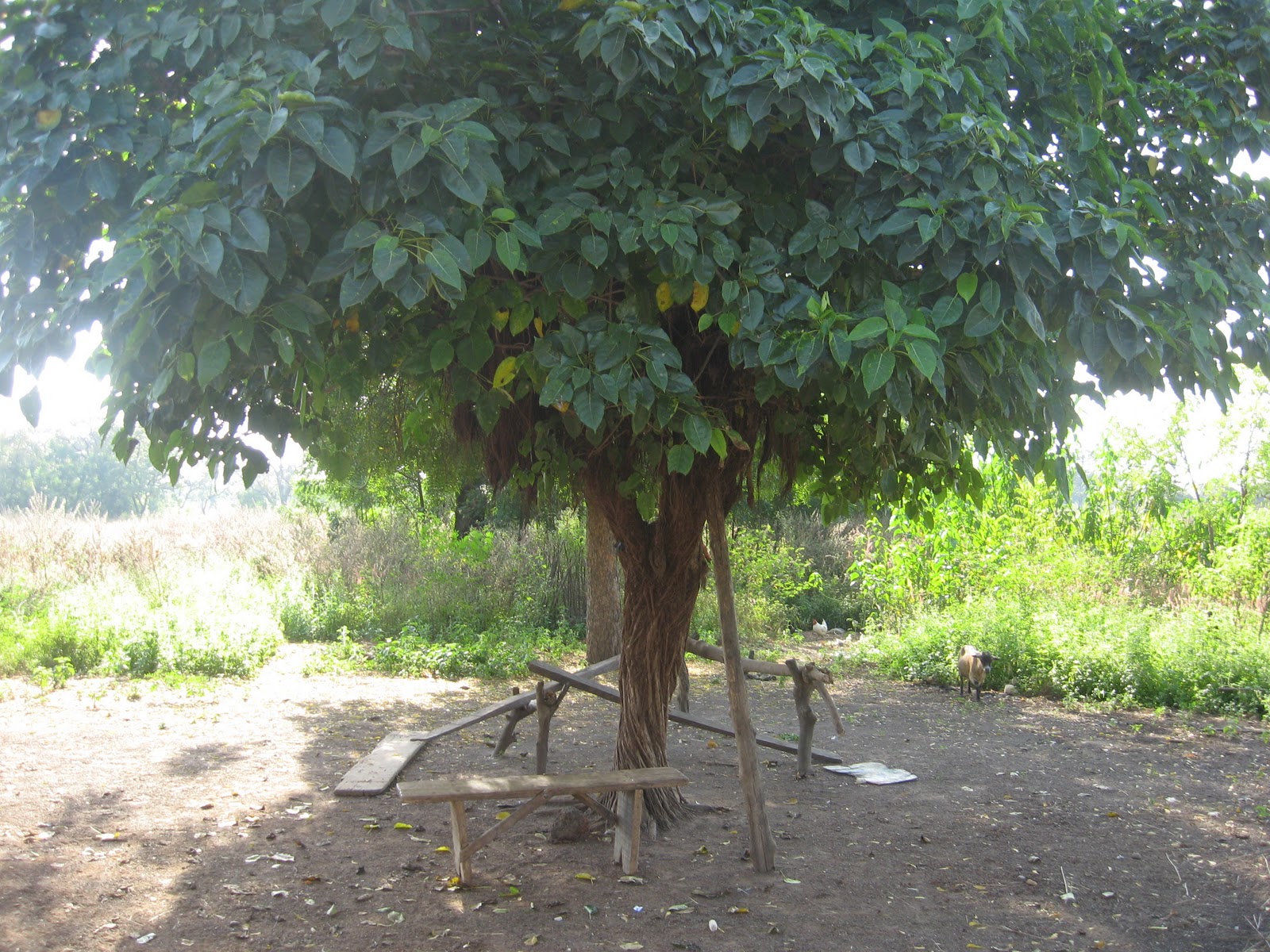
I spent most of my time in the village underneath a tree. One can see an amazing amount of life from underneath a tree in a rural village. Outside of the compound it is the center of life for the family. It is where the father sits and rests, meetings take place here; both formal and informal, lunch is often served here and work takes place in the shade.

This past week was spent in the community of Kulaa a community of 1800 people about 45 minutes from Tamale at the end of a bumpy, dusty red dirt road. My stay in the community was a chance to experience rural life in northern Ghana and while I was there I would also repair the bicycle my class donated last April and hold health and first aid classes for the women and children.

I finished packing my things Monday morning and set out for the community on the back of the motorcycle which Walisu crashed less than one hundred yards for house by going into the ditch at the side of our sandy road; I am still not sure how but before we went down I was able to step off the back of the bike, my huge pack and all—Walisu and the bike were also unharmed. The cause of the crash was the extra weight presented by my pack which included clothes for five days, bike tools and supplies, medical supplies to be donated, my medical kit, 3 liters of clean water plus a filter, and a bicycle pump—easily over fifty pounds of weight. This would continue to cause problems the entire way—it took all of my strength to hang on and potholes, ruts, and loose sand were a delicate feat.
Upon my arrival the women who would be taking the first aid class were assembled underneath a tree so they could meet me and so a time could be set for class the following day. While the women were leaving one boy of about eight was loaded up with a bench to take back home, and upon his mother placing it on his head he stumbled a few steps into the tree and fell over. With this done lunch was ate—yams and rice which was brought over by a neighbor for me; this was a common occurrence and resulted in many unsuccessful attempt to say that I was not hungry. After this I began working on some of the bikes. This soon turned into quite the event with everyone from children to old men assembling to watch and a few “helpers” joining in—these are usually enthusiastic but not very helpful apart from the many battles against rust where an extra set of arms is generally needed. There is also always a varied selection of dogs, cats, chickens, Guinea Fowls, and lots of goats around—one opportunistic rooster attempted to steal a ball bearing from me. The first two bikes took up the afternoon and then it was dinner time and a Guinea Fowl was slaughtered in my honor. At first the preparation caused some concern; after killing and roughly plucking the bird it was being held in the flames from a small grass fire and I was praying that it would be cooked in a more substantial manner but my fears were swept away when it disappeared into a pot and we did not eat for some time, giving it plenty of time to cook. It was served along with FuFu, a kind of yam dumpling served in soup, ate with your hands and swallowed without chewing, and was actually better then I remember Guinea Fowl being. The remainder of the night was spent sitting inside the compound and listening to the radio—a call in program asking the question ‘Is marriage without children a crime and is divorce the solution?” since there weren’t many callers and the host was not very talkative the majority of the hour was spent playing the same song on loop. During this time and aided by a nearly full moon I could see and hear the family I was staying with prepare for bed, with fitful infants being put to sleep, brothers and sisters playing on reed mats, and women resting after washing the dishes from dinner. The scene was cast against a night sky peeking in over the square and round thatched roofs of the compound with the moon light mingling with light coming from the dying coals of the cooking fire.

The next morning I was once again brought out of sleep by the usual morning sounds; the early call to prayer but without the crackling of speakers, the sound of bicycles wheeling by my window on the way to farms, and the talking and laughter of women as the fetched water. Sitting next to me was also a bowl of what was described as corn meal porridge but tasted more like soured milk—I waited for Walisu to arrive with the bread I had instructed him to bring. This also brings up the point of using the restroom.  One’s eyes were rewarded for their weak stomach by the beautiful, but often rushed, walk out of town to the bush. On this trip one also meets groups of farmers returning from their farms with their bicycles loaded down with their days work.

The training was supposed to start at 8:00am but as 8:30am arrived with Walisu I was once again reminded of “Africa Time” and we set off to investigate. We discovered that while some women were just late that a large portion of them were at a naming ceremony. A naming ceremony takes place eight days after the birth and is a big celebration with gifts being given to the family and lots of food being served.—a goat was being slaughtered as we arrived. When we entered the compound one of the traditional rituals was starting, the babies’ first hair cut, a little girl with a full head of hair was being given a shave by an old man with an equally old straight blade. We left and headed back to begin setting up for the training.

By this time the women were beginning to arrive and arrange themselves on benches beneath a tree. Walisu set about taking their names down along with their profession—the women attending were all members of the micro-finance group—number of children, and number of people in their compound; this ranged from one to ten children with most having three or four and up to fifty people in a compound. With forty-five brightly dressed women, most wearing brightly colored cloth wraps, old t-shirts and head scarves, and a collection of children assembled and the flip attached to another tree the training began with Walisu acting as translator. The first part of the training covered the basic causes of sickness focusing on the link between poor sanitation and infection. Then we moved on to the basic steps to prevent infection with the focus on using clean water, boiled and filtered, hand washing with soap, sanitary food prep, and the importance of keeping the compound clean and free of trash and stagnant water. We also focused on preventing sickness in their children. The lesson was interrupted as benches were moved around to ensure that they stayed in the shade and by the women periodically thanking me. After about an hour and a half the group broke up and Tesert and left over Guinea Fowl being served for lunch—Tesert is similar to FuFu but made out of corn meal and is a little more grainy. After this I took a nap under the tree on a very narrow and hard wooden bench. During the afternoon an old tractor arrived pulling an equally old corn sheller and this created a flurry of activity with every member of the compound grabbing buckets and large metal basins and rapidly began filling them with ears of corn and dumping them into the machine. There was a large pile of corn in the center of the compound along with one in a store room. This process lasted about forty-five minutes and was followed up with the process in reverse—scooping the corn kernels back into the buckets and dumping them back into the compound.  FuFu for dinner. Ghanaians love FuFu and Tesert and eat insane quantities of it very fast. I would sit next to the head of the compound and he would eat a bowl twice as big as mine before I could even eat half of mine, usually the extent of my apatite anyway.

The local Assemblyman stopped by this evening to visit me. And as we sat inside the moonlit compound we discussed the classes I was teaching as well as the bicycles. He also noticed that I was looking at the starts, those that could be seen anyways through the hazy African sky and the nearly full moon, and asked me if my country had stars and the moon. I said yes and that they’re the same stars and moon. He relayed this to my host and it seemed to cause some excitement and he responded that they thought that only Ghana had stars and the moon.

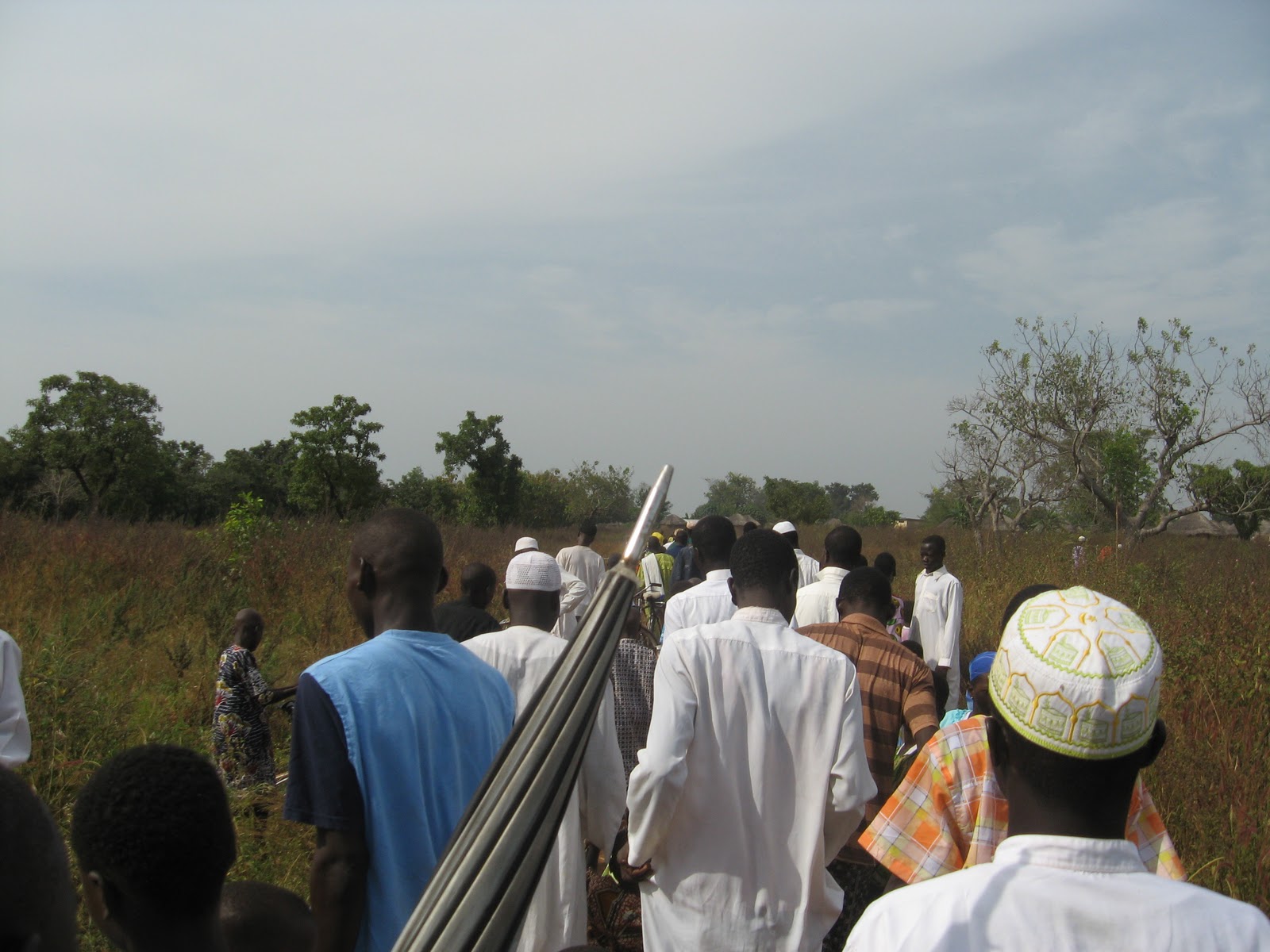
The next was the Muslim holy day of Eid al-Adha. There is no work done on this day and the first aid class would be postponed till the next day. As I sat underneath the tree outside the compound I heard the call to prayer but it was not coming from the Mosque it was rather coming from east of town and following this there was soon a steady stream of people walking past me on their way out of town. The men were wearing the long robes seen on Muslim men everywhere and here known as Zebas and the women were wearing colorful dresses and headscarves. As I sat there many people motioned for me to join them and a few who could speak English asked if I was going to go pray to Allah with them. I had got the feeling that I might go along with one of the members of the compound so I waited to see what would happen. And soon one of the sons in the compound came out holding a huge white traditional Shawl for me to wear, one of many blending of traditional aspects of life with Islam that one can find on the edges of religious empires. In a clearing on the edge of the village a large group of faithful had already gathered—several rows of mats crowded with men facing East, behind that a row of young boys on mats, behind them several rows of women, and then off to the side under a tree a collection of younger children and all around piles of sandals. I removed my sandals and joined the edge of a row but as more people squeezed in from the side and rows were added behind I soon found myself in the middle. The service began with the Clerics in front starting a call and response. Soon the gathering lowered itself to their knees and touched their foreheads to the ground, with the silence in between being disturbed by the tinkling of stones falling off of sweaty foreheads back to the ground. After this a sermon was given with my very limited Dagbani reveling it to be largely concerned about farming and the Cleric’s voice often being drowned out by the children underneath the tree. During this time an umbrella was also brought and held over me. With this the service ended with a good number of men coming up greeting me and shaking my hand, and as I followed the surge back to the village the handshaking only stopped because my hands were being held by several kids. This holy day focuses around the sacrificing of rams and soon you could see large rams being killed and cooked which was soon followed by kids delivering pieces of meat over to neighbors along with other bowls of food—after the first class the women remarked that they would be doing a lot of cooking tomorrow and that they would use what I had taught them. The afternoon was spent fixing another bicycle which once again attracted a large crowd and was interrupted several times by a group of traditional drummers who were circling around the village. This group was also drinking and handing out packets of gin and I know I had seen at least one of them praying this morning. I spent the rest of the afternoon fixing the third bicycle and dinner was once again Tesert but this time it was accompanied by three pieces of goat; two of which were recognizable and one of which I deemed edible. One was just a hunk of meat and was the best goat I have had so far, one was a roll of skin, and the other was unidentifiable.

The next morning I completed my first aid training with the women and we covered basic wound care focusing on preventing infection,  how to handle major bleeding, care of burns, and the use of Oral Rehydration Salts for their children. I also covered snake bites which are a common occurrence during Shea nut harvesting. Throughout the training the women had been very receptive and accepting of my information frequently thanking me and saying that this would greatly help their families but when Walisu relayed my information about treating snake bites I could tell that it caused some issues. Before hand I had asked them to describe the affects of snake bites and they said that there were several but that there was one that caused the most problems for them. After the bite the person would start bleeding out of any open wounds or scars and would eventually lose the ability to walk and that they go to the hospital for this one. I said that they should apply a pressure bandage to the bitten area to slow the venoms spread but the local belief is that this will anger the venom and if the it is confined to the arm then it will just do damage to the arm and it would have to be amputated. I tried to reinforce the idea behind my method but I’ll give it a 50/50 shot of being followed.
Following the training I presented the group with a bag of medical supplies consisting of bandages and dressings, and some Oral Rehydration Salts. I was once again thanked profusely and was almost always saying “Amie” the response for a blessing.

Before I left to return to Tamale I made several house calls to sick women. One of which was suffering from heat exhaustion and dehydration after walking twelve miles in the sun to attend a funeral and then walking the twelve miles back the next day. The majority of the women were sick with stomach cramps caused by bad water so I just mentioned the importance of drinking clean water, most households have a filter of some type but it is often underused, and prescribed diets of tea and plain rice.

It should be noted that wherever I went the men would always thank me for teaching their women and recognized the need to educate their families about good hygiene. And just like they were very welcoming when it came to me attending their religious ceremony they were also comfortable we me talking to their wives about their illnesses, which since they all concerned stomach issues resulted in me asking rather personal questions.

Before we left another round of FuFu was in order with a good measure of unidentifiable goat. As I was preparing to leave my host handed me a big bag full of bananas. Here I was making frantic trips to the bathroom and suffering through questionable goat and he was holding out on me, by the second day I would have killed for a banana. Now it just gave me another thing to hold on to on the back of the bike.

On Friday afternoon I returned to Kulaa to teach a first aid class to some of the older students. This was not quite as successful as the women’s’ classes. I was once again hoping to target the young girls who are often responsible for water and cooking, two areas of focus, but it appears that they had not been informed and were all out at the farms. So we delayed and a few younger girls were rounded—most carrying or being followed by a younger child. I will return to Kulaa once again today and finish teaching. Also before the class started I was treated to another round of FuFu and goat.

 The Pack
 Shade tree Mechanic
 My Host
 First day of training


 Walking back from praying
 Happy Bikes Happy Kids

 My room
 Walk to the toilet
 Some of the family living in the compound
 The compound
 Outside of my room
 The Tree
 Presenting the medical supplies. I also donated bars of soap.


Sunday, November 14, 2010

TroTros and Waterfalls

Updated: pictures below
On Saturday day morning I met up with several other volunteers, an American girl, two girls from Belgium, and two Irish guys, to go visit some waterfalls. We had a seven o’clock meeting time at the TroTro station, and when all were assembled we located the TroTro to Kintimpo. After all the seats had been sold and several goats were loaded into the trunk the old Mercedes departed for the three hour journey.  There were seven rows of seats, five seats across plus three people in the front seat; add the three previously mentioned goats and we rolled out of town with forty-one passengers. My seat was a fold down seat located in the aisle in the second to last row, which was precariously placed on a large hump located over the rear axle and trunk area. These created the slightly awkward situation of me not being able to touch the floor with my feet, they were just dangling there like I was sitting on an overlarge sofa but with none of the comfort-I don’t believe that there is a single comfortable seating surface in Ghana and it will definitely not be found in a TroTro if it does exist. I was eventually able to find a comfortable position and even dozed some but one of the Belgium girls behind me, who was sitting completely on the hump, was in constant fear of knocking her teeth out on her own knees every time we hit a speed bump or a pot hole—also when we hit a especially large bump you could hear the goats bounce around and scream in the trunk.

We arrived at the first set of waterfalls that were located right next to the road and was set up very nicely with picnic areas and a trail that took you to several falls. The biggest fall was located last and only came into view after a treacherous descent of one hundred and fifty-two steps. The falls were very large and you could swim in the shallow pool beneath them and climb up and sit underneath the cascades of water. This however was a very tricky task as the rocks were extremely slippery and the water as you past underneath it was extremely forceful but once you were safely perched underneath it was very enjoyable. Exiting was also a bit of adventure and eventually just involved sliding down the rocks hoping you had picked the smoothest path. One Speedo clad German tourist that arrived as we were leaving picked the wrong path and had a very bouncy ride over some rocks.

We then walked back with the intention of catching a ride to another set of waterfalls located a little farther away. The first TroTro that past picked us up and said that he would take us to the falls. We dropped off several other passengers in Kintimpo, and the driver decided to run some errands; he filled up with fuel, bought some bread,  swapped out his cell phone battery, and just stopped to talk to a friend for a few minutes, after that we were on our way to the falls. This involved first a very potholed and hilly road, which on one pockmarked stretch of downhill some unidentified piece of metal clattered off from the front left corner—did not stop to investigate—next up was a dirt road which we turned off of onto what can only be described as dirt track which our driver successfully navigated in his old Nissan micro van.

This was by far a less visited area and was rather under developed; our arrival interrupted an old man sleeping under a tree who was in charge of admission. At one point it looked like the falls had served as a religious area with the vestiges of a church scattered around the rocks in the stream and connected by little bridges. This fall had a much deeper pool at the bottom and the current was quite strong, with another fall lower down encouraging you to measure your strokes. We were also told that it was deep enough to jump off of one of steps, so battling the rushing water we worked our way out into the falls and took a very hesitant first jump—it was deep enough.

We had asked our TroTro driver to hang around since we were pretty far off the beaten path and after some more jumps we departed. On our drive back we discovered that there had been a miscommunication regarding the fare. When we had entered the van we had inquired about the fare to the falls and he said fifty peswas (cents) and we thought that sounded good. He however thought we were asking about the fare to town and not the falls so when we asked about the fare he said six cidis (dollars) a person. Now we had discussed this before hand and figured since it was round trip and he had waited that two cidis sounded fair. He was not happy so we when made it back to town the discussion continued. He came down to twenty cidis and then eighteen and we finally left with just putting sixteen cidis on the front seat and walking away from him.

We then went to the TroTro station and purchased tickets to Tamale for five cidis. We then waited around for the TroTro to arrive and ate some roasted yams and plantains. Then as we were standing there we saw our old friend from the TroTro to falls pull up and we discovered that he would be our TroTro back to Tamale. We made it into the van without him noticing us but then when he was loading luggage into the back he saw us and remarked, “Oh no, it you.” So an auspicious start to a now four hour journey through the night. Also while this was taking place more and more people were piling in; eighteen in totals—anywhere else this van would carry nine people at most. I was crammed into the back left corner sitting sideways and crouched down due to lack of head room, leg room non-existence.  We also felt rather concerned for another American girl who was sitting on the engine cover in the front row and was positioned about a foot higher than everyone else and about six inches from the already cracked windshield. The van also became more crowded when we picked up another passenger in a village. This lady also had two rather large bags with her that were added to the area behind the back bench. Now this presented several problems, mainly closing the back hatch, so it was lashed down and we set off again with the back door open about a foot. This is when we also realized that the last bench might be removable and appeared to be loosely bolted down—this made potholes and speed bumps more worry some along with the fact that having the rear end open severely affected the rigidity of the vehicle. The one good point being that circulation greatly improved in my small space because my window could not be opened.

To pass the time we decided to play some travel games including the one where each person says a phrase or a word in turn to make a story. We thought this was a great success—we even enlisted one Ghanaian man into the game, he was pretty good. However, if you remember I mentioned that the interior of TroTros have a rather somber mood and our merry making was not appreciated by all. So after being yelled at we ended the game and quieted down for the remainder of the ride.

Upon exiting the TroTro we set about stamping feeling back into our legs, working the creaks out of necks, and checking for bruises. After this we then went and ate a western style restaurant where I had a very delicious cheeseburger and fries. This meal was much needed and has had a positive effect on my digestion.
Today I am getting my stuff in order for this week’s stay out in one of the villages. I will be about forty-five minutes by motorcycle outside of Tamale. This is where I will be holding some basic first aid classes as well as repairing the bicycles that were donated last spring. I will update you on this upon my return at the end of the week.


Friday, November 12, 2010

Fields


Yesterday I left the dirt road and journeyed into fields of northern Ghana—a mix of agricultural land and native grasses. I was in search of the focal person for the community that I would be staying with next week. This being harvest time he was in his fields and that is where we found him. Taking an oft hidden path through a tall grass prairie of sorts, and with the help of several farmers along the way we finally located him husking corn underneath a tree with two companions, their bicycles and pail lunches close at hand. As we talked the corn grew higher and higher on expectant piles waiting to be carried away, either in bags strapped to the racks of bicycles or on the heads of women—both a common sight on the dusty red roads.  Agriculture here is carried out almost entirely by hand; corn is picked, husked, and shelled by hand and then left to dry in the middle of compounds, rice is cut with a sickle and processed entirely by hand.  I feel I need to mention that down the street from where I live there is a old John Deere combine with a rice head on it, which I have seen move once but I feel like by the time it enters the fields there will be little rice left for it to harvest.

Reflecting on this I came to the realization that agriculture in the U.S. was not so different a hundred years ago—the main difference being the complete absence of horses in Ghana. While riding around the country side it seems impossible for farmers to either compete with or reach the level of western farmers. Modern American farming was born in the post Great Depression post WWII era. And it was largely driven by the federal government in the form of assistance to farmers, both veterans and those that farmed though the War. Through this massive influx of money, technology, and education American farming modernized and was able to feed the world. Taking a long approach to viewing development it is possible to see that in one hundred years Ghana could also be an agricultural center. People will lament the climate but a cold season is just replaced by a dry season; are the desolate winters of the upper Midwest any less forgiving than a long and hot dry season—both deserts? Like farm workers everywhere Ghanaian farmers are hard working and resourceful, they are just lacking assistance, the type of assistance that helped American farmers transform theirs and their communities’ lives. If the Ghanaian government could help farmers buy land, seed, fertilizer, equipment, and education and training they could easily feed the world.

So while it is possible for Ghanaian farmers to compete on the world market, the world market must remember where it came from and realize that the African farmer today deserves every assistance that was provided to the American farmer fifty years ago.

Visiting small farming communities, one or two room rural schools, and seeing whole families working in the fields together all against the stunning background of savannah land it is hard to compare it to the stories of Willa Cather set around the struggle of farmers in the American Midwest—a land that at the time seemed just as untamable as the savannah is today.