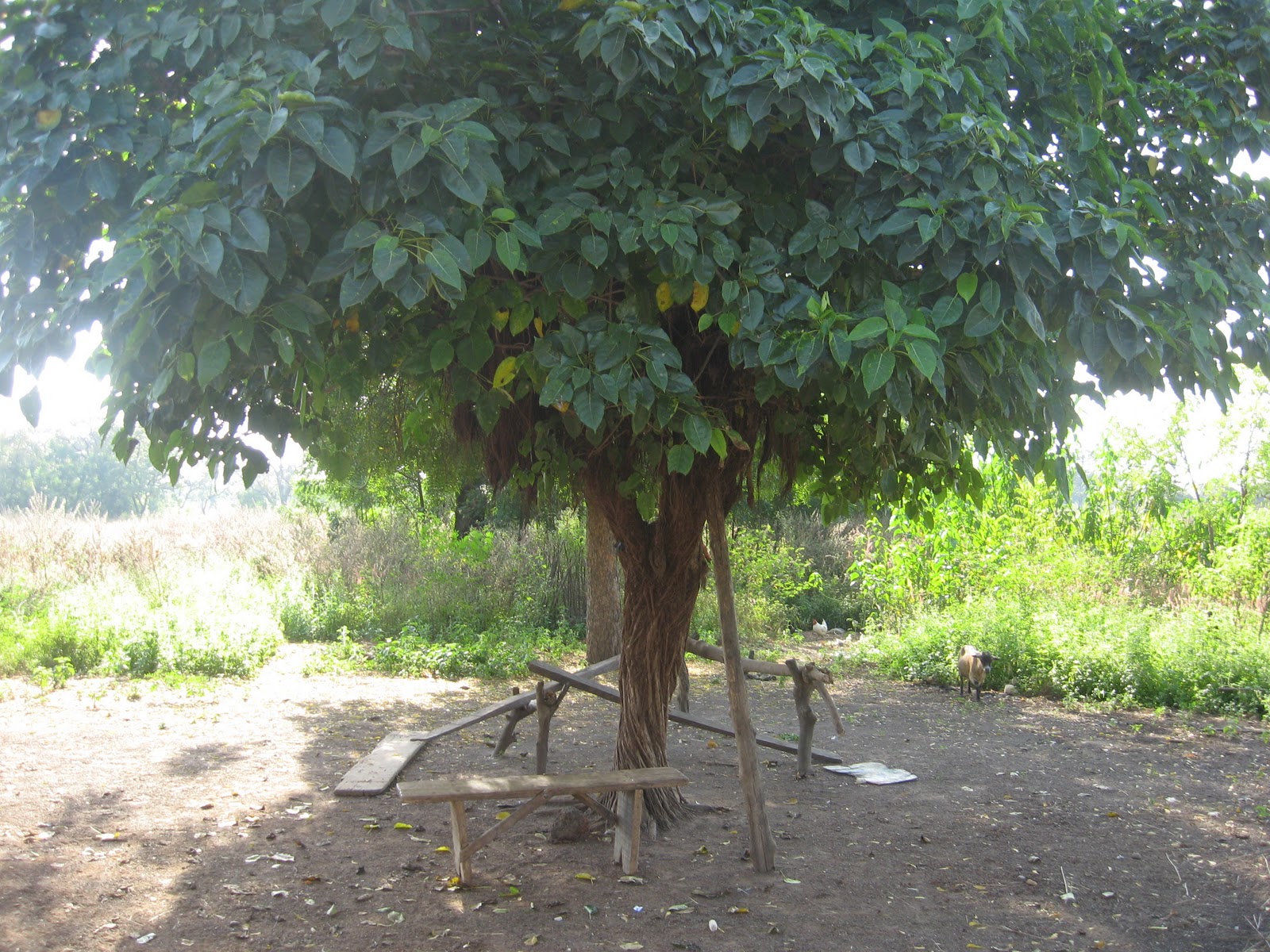
I spent most of my time in the village underneath a tree. One can see an amazing amount of life from underneath a tree in a rural village. Outside of the compound it is the center of life for the family. It is where the father sits and rests, meetings take place here; both formal and informal, lunch is often served here and work takes place in the shade.
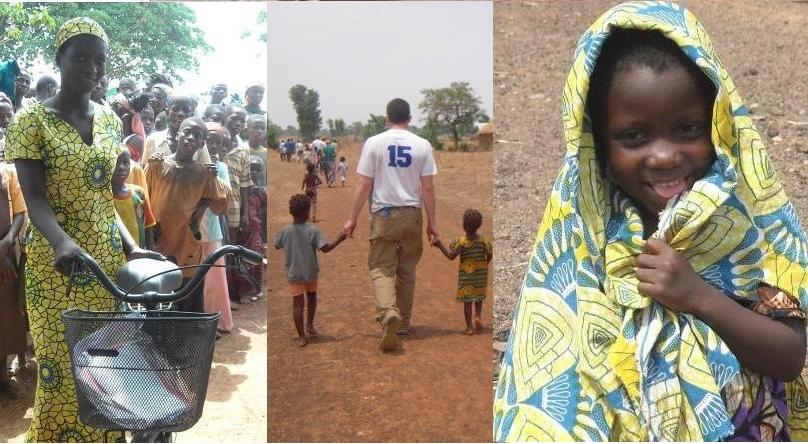
This past week was spent in the community of Kulaa a community of 1800 people about 45 minutes from Tamale at the end of a bumpy, dusty red dirt road. My stay in the community was a chance to experience rural life in northern Ghana and while I was there I would also repair the bicycle my class donated last April and hold health and first aid classes for the women and children.
I finished packing my things Monday morning and set out for the community on the back of the motorcycle which Walisu crashed less than one hundred yards for house by going into the ditch at the side of our sandy road; I am still not sure how but before we went down I was able to step off the back of the bike, my huge pack and all—Walisu and the bike were also unharmed. The cause of the crash was the extra weight presented by my pack which included clothes for five days, bike tools and supplies, medical supplies to be donated, my medical kit, 3 liters of clean water plus a filter, and a bicycle pump—easily over fifty pounds of weight. This would continue to cause problems the entire way—it took all of my strength to hang on and potholes, ruts, and loose sand were a delicate feat.
Upon my arrival the women who would be taking the first aid class were assembled underneath a tree so they could meet me and so a time could be set for class the following day. While the women were leaving one boy of about eight was loaded up with a bench to take back home, and upon his mother placing it on his head he stumbled a few steps into the tree and fell over. With this done lunch was ate—yams and rice which was brought over by a neighbor for me; this was a common occurrence and resulted in many unsuccessful attempt to say that I was not hungry. After this I began working on some of the bikes. This soon turned into quite the event with everyone from children to old men assembling to watch and a few “helpers” joining in—these are usually enthusiastic but not very helpful apart from the many battles against rust where an extra set of arms is generally needed. There is also always a varied selection of dogs, cats, chickens, Guinea Fowls, and lots of goats around—one opportunistic rooster attempted to steal a ball bearing from me. The first two bikes took up the afternoon and then it was dinner time and a Guinea Fowl was slaughtered in my honor. At first the preparation caused some concern; after killing and roughly plucking the bird it was being held in the flames from a small grass fire and I was praying that it would be cooked in a more substantial manner but my fears were swept away when it disappeared into a pot and we did not eat for some time, giving it plenty of time to cook. It was served along with FuFu, a kind of yam dumpling served in soup, ate with your hands and swallowed without chewing, and was actually better then I remember Guinea Fowl being. The remainder of the night was spent sitting inside the compound and listening to the radio—a call in program asking the question ‘Is marriage without children a crime and is divorce the solution?” since there weren’t many callers and the host was not very talkative the majority of the hour was spent playing the same song on loop. During this time and aided by a nearly full moon I could see and hear the family I was staying with prepare for bed, with fitful infants being put to sleep, brothers and sisters playing on reed mats, and women resting after washing the dishes from dinner. The scene was cast against a night sky peeking in over the square and round thatched roofs of the compound with the moon light mingling with light coming from the dying coals of the cooking fire.
The next morning I was once again brought out of sleep by the usual morning sounds; the early call to prayer but without the crackling of speakers, the sound of bicycles wheeling by my window on the way to farms, and the talking and laughter of women as the fetched water. Sitting next to me was also a bowl of what was described as corn meal porridge but tasted more like soured milk—I waited for Walisu to arrive with the bread I had instructed him to bring. This also brings up the point of using the restroom. One’s eyes were rewarded for their weak stomach by the beautiful, but often rushed, walk out of town to the bush. On this trip one also meets groups of farmers returning from their farms with their bicycles loaded down with their days work.
The training was supposed to start at 8:00am but as 8:30am arrived with Walisu I was once again reminded of “Africa Time” and we set off to investigate. We discovered that while some women were just late that a large portion of them were at a naming ceremony. A naming ceremony takes place eight days after the birth and is a big celebration with gifts being given to the family and lots of food being served.—a goat was being slaughtered as we arrived. When we entered the compound one of the traditional rituals was starting, the babies’ first hair cut, a little girl with a full head of hair was being given a shave by an old man with an equally old straight blade. We left and headed back to begin setting up for the training.
By this time the women were beginning to arrive and arrange themselves on benches beneath a tree. Walisu set about taking their names down along with their profession—the women attending were all members of the micro-finance group—number of children, and number of people in their compound; this ranged from one to ten children with most having three or four and up to fifty people in a compound. With forty-five brightly dressed women, most wearing brightly colored cloth wraps, old t-shirts and head scarves, and a collection of children assembled and the flip attached to another tree the training began with Walisu acting as translator. The first part of the training covered the basic causes of sickness focusing on the link between poor sanitation and infection. Then we moved on to the basic steps to prevent infection with the focus on using clean water, boiled and filtered, hand washing with soap, sanitary food prep, and the importance of keeping the compound clean and free of trash and stagnant water. We also focused on preventing sickness in their children. The lesson was interrupted as benches were moved around to ensure that they stayed in the shade and by the women periodically thanking me. After about an hour and a half the group broke up and Tesert and left over Guinea Fowl being served for lunch—Tesert is similar to FuFu but made out of corn meal and is a little more grainy. After this I took a nap under the tree on a very narrow and hard wooden bench. During the afternoon an old tractor arrived pulling an equally old corn sheller and this created a flurry of activity with every member of the compound grabbing buckets and large metal basins and rapidly began filling them with ears of corn and dumping them into the machine. There was a large pile of corn in the center of the compound along with one in a store room. This process lasted about forty-five minutes and was followed up with the process in reverse—scooping the corn kernels back into the buckets and dumping them back into the compound. FuFu for dinner. Ghanaians love FuFu and Tesert and eat insane quantities of it very fast. I would sit next to the head of the compound and he would eat a bowl twice as big as mine before I could even eat half of mine, usually the extent of my apatite anyway.
The local Assemblyman stopped by this evening to visit me. And as we sat inside the moonlit compound we discussed the classes I was teaching as well as the bicycles. He also noticed that I was looking at the starts, those that could be seen anyways through the hazy African sky and the nearly full moon, and asked me if my country had stars and the moon. I said yes and that they’re the same stars and moon. He relayed this to my host and it seemed to cause some excitement and he responded that they thought that only Ghana had stars and the moon.
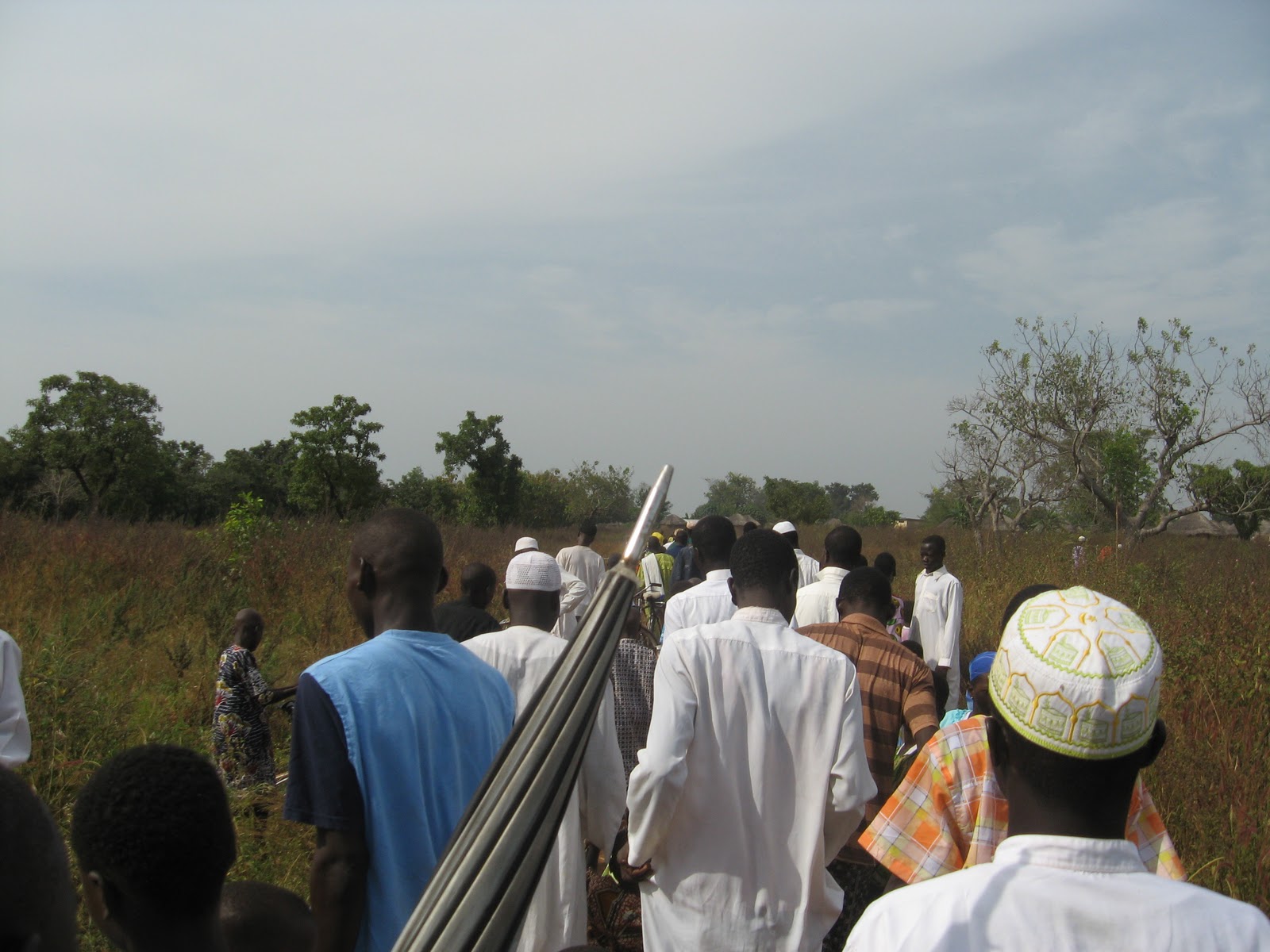
The next was the Muslim holy day of Eid al-Adha. There is no work done on this day and the first aid class would be postponed till the next day. As I sat underneath the tree outside the compound I heard the call to prayer but it was not coming from the Mosque it was rather coming from east of town and following this there was soon a steady stream of people walking past me on their way out of town. The men were wearing the long robes seen on Muslim men everywhere and here known as Zebas and the women were wearing colorful dresses and headscarves. As I sat there many people motioned for me to join them and a few who could speak English asked if I was going to go pray to Allah with them. I had got the feeling that I might go along with one of the members of the compound so I waited to see what would happen. And soon one of the sons in the compound came out holding a huge white traditional Shawl for me to wear, one of many blending of traditional aspects of life with Islam that one can find on the edges of religious empires. In a clearing on the edge of the village a large group of faithful had already gathered—several rows of mats crowded with men facing East, behind that a row of young boys on mats, behind them several rows of women, and then off to the side under a tree a collection of younger children and all around piles of sandals. I removed my sandals and joined the edge of a row but as more people squeezed in from the side and rows were added behind I soon found myself in the middle. The service began with the Clerics in front starting a call and response. Soon the gathering lowered itself to their knees and touched their foreheads to the ground, with the silence in between being disturbed by the tinkling of stones falling off of sweaty foreheads back to the ground. After this a sermon was given with my very limited Dagbani reveling it to be largely concerned about farming and the Cleric’s voice often being drowned out by the children underneath the tree. During this time an umbrella was also brought and held over me. With this the service ended with a good number of men coming up greeting me and shaking my hand, and as I followed the surge back to the village the handshaking only stopped because my hands were being held by several kids. This holy day focuses around the sacrificing of rams and soon you could see large rams being killed and cooked which was soon followed by kids delivering pieces of meat over to neighbors along with other bowls of food—after the first class the women remarked that they would be doing a lot of cooking tomorrow and that they would use what I had taught them. The afternoon was spent fixing another bicycle which once again attracted a large crowd and was interrupted several times by a group of traditional drummers who were circling around the village. This group was also drinking and handing out packets of gin and I know I had seen at least one of them praying this morning. I spent the rest of the afternoon fixing the third bicycle and dinner was once again Tesert but this time it was accompanied by three pieces of goat; two of which were recognizable and one of which I deemed edible. One was just a hunk of meat and was the best goat I have had so far, one was a roll of skin, and the other was unidentifiable.
The next morning I completed my first aid training with the women and we covered basic wound care focusing on preventing infection, how to handle major bleeding, care of burns, and the use of Oral Rehydration Salts for their children. I also covered snake bites which are a common occurrence during Shea nut harvesting. Throughout the training the women had been very receptive and accepting of my information frequently thanking me and saying that this would greatly help their families but when Walisu relayed my information about treating snake bites I could tell that it caused some issues. Before hand I had asked them to describe the affects of snake bites and they said that there were several but that there was one that caused the most problems for them. After the bite the person would start bleeding out of any open wounds or scars and would eventually lose the ability to walk and that they go to the hospital for this one. I said that they should apply a pressure bandage to the bitten area to slow the venoms spread but the local belief is that this will anger the venom and if the it is confined to the arm then it will just do damage to the arm and it would have to be amputated. I tried to reinforce the idea behind my method but I’ll give it a 50/50 shot of being followed.
Following the training I presented the group with a bag of medical supplies consisting of bandages and dressings, and some Oral Rehydration Salts. I was once again thanked profusely and was almost always saying “Amie” the response for a blessing.
Before I left to return to Tamale I made several house calls to sick women. One of which was suffering from heat exhaustion and dehydration after walking twelve miles in the sun to attend a funeral and then walking the twelve miles back the next day. The majority of the women were sick with stomach cramps caused by bad water so I just mentioned the importance of drinking clean water, most households have a filter of some type but it is often underused, and prescribed diets of tea and plain rice.
It should be noted that wherever I went the men would always thank me for teaching their women and recognized the need to educate their families about good hygiene. And just like they were very welcoming when it came to me attending their religious ceremony they were also comfortable we me talking to their wives about their illnesses, which since they all concerned stomach issues resulted in me asking rather personal questions.
Before we left another round of FuFu was in order with a good measure of unidentifiable goat. As I was preparing to leave my host handed me a big bag full of bananas. Here I was making frantic trips to the bathroom and suffering through questionable goat and he was holding out on me, by the second day I would have killed for a banana. Now it just gave me another thing to hold on to on the back of the bike.
On Friday afternoon I returned to Kulaa to teach a first aid class to some of the older students. This was not quite as successful as the women’s’ classes. I was once again hoping to target the young girls who are often responsible for water and cooking, two areas of focus, but it appears that they had not been informed and were all out at the farms. So we delayed and a few younger girls were rounded—most carrying or being followed by a younger child. I will return to Kulaa once again today and finish teaching. Also before the class started I was treated to another round of FuFu and goat.